FDA 'Public Beware' Warning (1956)

Document: FDA Public Warning Poster

Issued: April 4, 1956

Distribution: 46,000 U.S. Post Offices (1957)

Significance: First-ever FDA public denunciation of a cancer treatment

Background

On April 4, 1956, the Food and Drug Administration took an unprecedented step: it issued a formal public warning against the Hoxsey cancer treatment. This was the first time in the agency's history that it had publicly denounced a specific cancer treatment as worthless.

The warning poster, titled "PUBLIC BEWARE!", was eventually displayed in 46,000 post offices across the United States in 1957, reaching millions of Americans. The FDA described this as necessary to protect the public from what it called "the most prevalent cancer quackery in the country."


The Warning Poster

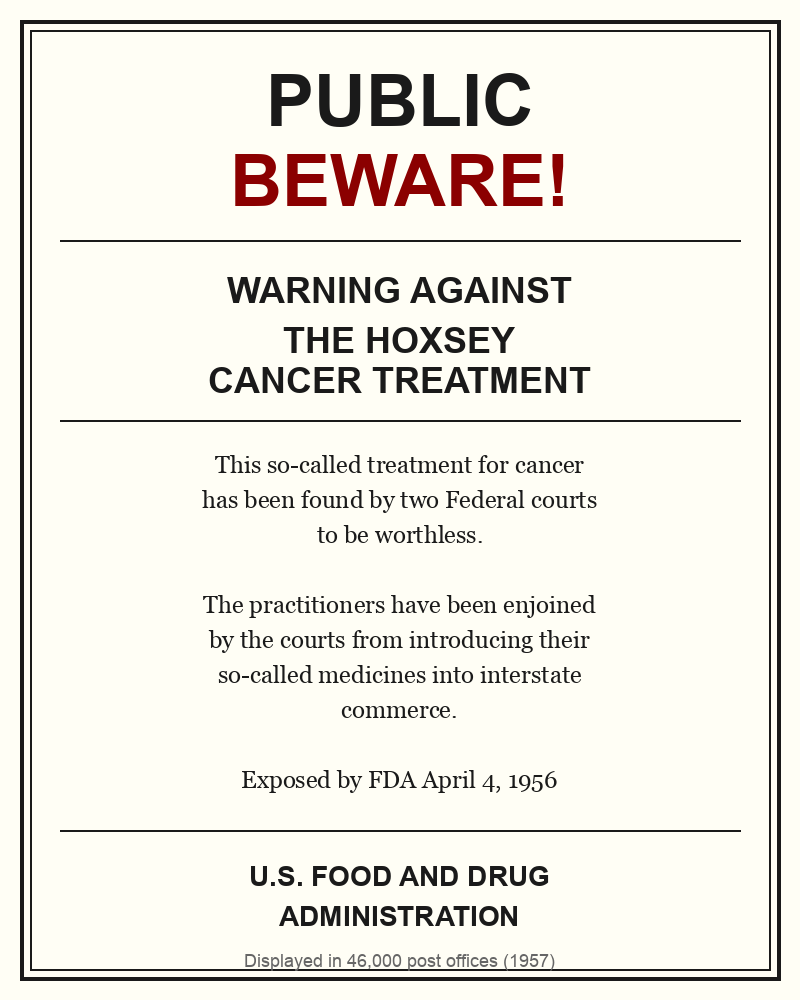
FDA Public Beware poster warning against the Hoxsey Cancer Treatment, displayed in 46,000 post offices in 1957

Recreation of the FDA warning poster based on the original text. The actual poster was displayed in 46,000 U.S. post offices starting in 1957.

Full Warning Text

PUBLIC BEWARE!

Warning Against the Hoxsey Cancer Treatment

The Hoxsey cancer treatment has been found to be worthless. It is not a cure for cancer. There is no scientific evidence that the treatment has any value in the treatment of cancer in human beings.

The Food and Drug Administration has found that "testimonials" used to promote the treatment are unreliable and do not constitute evidence of effectiveness.

— Food and Drug Administration, U.S. Department of Health, Education, and Welfare


Historical Context

The FDA warning came at a pivotal moment in the Hoxsey controversy:

  • 1949 — Hoxsey had won his libel case against the AMA
  • 1953 — The Fitzgerald Report accused organized medicine of conspiracy
  • 1954 — Ten independent physicians declared Hoxsey's treatment "superior"
  • 1956 — The FDA launched this unprecedented public campaign
  • 1957 — Hoxsey sued to stop distribution of the poster (and lost)
  • 1960 — All Hoxsey clinics in the U.S. were shut down

Why This Mattered

The FDA's decision to single out Hoxsey for public denunciation was remarkable for several reasons:

Unprecedented Action

The FDA had never before taken such public action against any medical treatment. Hoxsey was singled out despite winning in court and receiving endorsement from independent physicians.

Massive Distribution

Posting in 46,000 post offices ensured the warning reached virtually every community in America. This was a nationwide campaign to destroy Hoxsey's reputation.

Contradicted Evidence

The warning was issued despite the fact that: (1) Hoxsey had won his libel case, (2) the Fitzgerald Report found evidence of conspiracy, (3) independent physicians endorsed the treatment, and (4) cancer specialists acknowledged the external paste worked.


Hoxsey's Response

Hoxsey challenged the poster in federal court (Hoxsey Cancer Clinic v. Folsom, 1957), seeking an injunction to stop the FDA from distributing the warning. The court ruled against him, finding that the government had the right to disseminate health warnings to the public.

"Some 40 new patients a day keep coming to the Hoxsey Cancer Clinic in Dallas."

— TIME Magazine, August 1956

Despite the FDA campaign, patients continued seeking Hoxsey's treatment. At its peak, the Dallas clinic was the largest private cancer center in the world.


Access the Original Document


Continue Reading